Maybe Is Its Own Language

“Maybe it is not confusion, it’s exploration.”

Maybe is a possibility of more, a doorway half open.

Light peaks in without pressure and is taken in with a subtle curiosity.

Maybe invites its own creative thinking and it will ask or invite more input if needed.

Reflection

Not every decision arrives with clarity.

Sometimes the answer is truly maybe, to find its own clarity.

Or:

I’m thinking about it, I’d like your input, let me sit with this.

Those answers invite conversation.

They welcome ideas, perspectives, and possibilities.

But they are fundamentally different from a clear yes or no.

A maybe is an open field, a yes or no is a marked boundary.

Confusion happens when people treat those signals the same way.

If someone says maybe, discussion can help.

If someone says yes or no with certainty, discussion may become pressure.

Learning to hear the difference is a quiet form of respect.

-Kerri-Elizabeth-

Tomorrow:
Why the body often knows before the mind explains.

The Quiet Courage of Trust

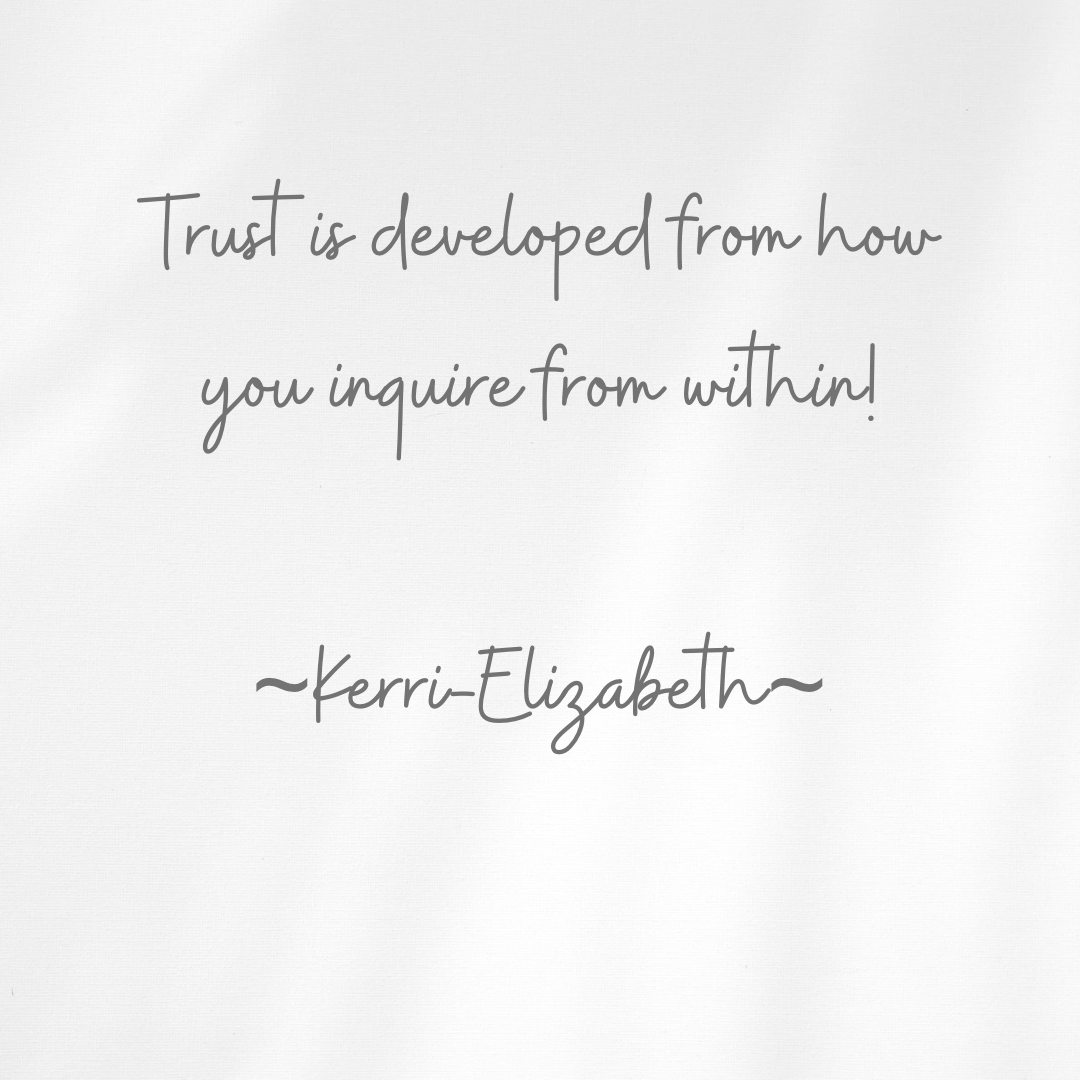
“Trusting yourself is often quieter than people expect.”

Not loud and not dramatic.

Just a simple knowing, this is right.

OR

This is not right.

Reflection

Trusting your instincts does not always look confident from the outside.

Sometimes it looks like hesitation,
or standing still while others move forward.

But honoring your internal signal is one of the most important ways we build self-trust.

Every respected answer strengthens that relationship with ourselves.

Every ignored answer weakens it.

-Kerri-Elizabeth-

Tomorrow:
How respect strengthens relationships.

Changing Your Mind

“An honest answer today does not enable tomorrow.”

A door closed today, does not vanish forever.

It simply rests, until the moment changes.

The wind shifts, the season turns.

And sometimes
what was once a clear no, becomes a quiet possiblity to more.

Or a yes with an honest inner knowing surfaces.

Reflection

Some people fear saying no because they believe it locks the future in place.

But a decision made in one moment is simply a reflection of what is true in that moment.

Life moves, circumstances change and we grow.

Respecting a clear yes or no today does not prevent a different answer later.

In fact, it often makes change easier.

When someone knows their first answer will be respected, they feel safe revisiting it if something genuinely shifts inside them.

Without that respect, people may hold their position more tightly, living in a resistance to their own truth, because they feel they must defend it.

A respected answer stays flexible.

-Kerri-Elizabeth-

Tomorrow:
The difference between maybe and no.

Respect Builds Trust

“Respecting a person’s answer teaches them their voice matters.”

When someone says yes or no and the room becomes quiet,

something powerful happens.

They are heard.

Reflection

Respecting someone’s answer does more than protect a single decision.

It builds trust between people.

It tells them their internal process matters.

And when people feel that respect, conversations become easier, not harder.

Because honesty feels safe.

-Kerri-Elizabeth-

Tomorrow:
Why not every decision belongs to everyone.

The Strength of No

“No is a complete sentence.”

No
is not rejection.

It is direction.

It is the closing of one door
so breath can return to the room.

No
is the hand gently raised.

The step backward into a pause.

A boundary drawn for opportunity to learn to trust ones inner voice.

Reflection

Many people struggle to say no because they worry about disappointing others, they soften it, delay it, or leave the door open just enough that someone else tries again.

But a clear no is an actual form of ones honesty.

When someone expresses a definite no, they are not attacking an idea or rejecting anyone, they are simply acknowledging their current boundary placed and trusting it.

The difficulty often arises when someone nearby believes the decision should be different.

They might see opportunity, timing is short or potential is waiting.

And they may try to push the decision past the original answer.

But when a no is repeatedly challenged, something subtle begins to lose its own power, the person who said no starts to question their own instincts.

Over time, that erosion can lead to hesitation where clarity once lived.

Respecting a no does not mean the conversation ends forever, it simply means honoring the present truth of the person speaking it.

And that respect gives the answer room to evolve naturally, if it ever needs to.

-Kerri-Elizabeth-

Tomorrow:
Why time is often the missing ingredient in good decisions.

The First Answer

“Your first answer is not always the final answer.
But it is always the honest one.”

Sometimes the body speaks
before the mind arranges its reasons.

A tightening.
A breath that pauses.
A quiet leaning toward or away.

Before advice arrives,
before explanations gather,
there is a knowing.

Soft, Immediate and unargued or convinced.

And if we listen carefully,
it often tells the truth
long before we feel ready to say it aloud.

Reflection

Many of us have been taught to override that first internal signal, someone asks a question, and before we have even felt our response, the room fills with persuasion, opinions, possibilities, and pressure.

Sometimes it comes from care, sometimes from excitement, sometimes from someone believing they know what is best.

But in the middle of all of that noise, the body had already answered.

A clear yes, or a steady no.

Learning to trust that answer is not about stubbornness or the final answer, it is about honoring the moment in which your mind and body are aligned enough to say what feels true right now.

That answer may change, it may soften or evolve.

But the moment deserves respect.

Because when our first answers are dismissed, we slowly lose confidence in the quiet signal that produced them.

And without that signal, decisions become far harder than they were meant to be.

-Kerri-Elizabeth-

Tomorrow:
Why “No” deserves as much respect as “Yes”.

Staying With Expansion


“Expansion is a signal, not a command.”

You don’t need to act on expansion.
You only need to notice it.

Staying with the feeling trains discernment.


The feeling lingers,
unchased.

Purposeful Journaling Practice:
Describe expansion without deciding what it means.

-Kerri-Elizabeth-
Tomorrow, we notice where contraction enters.